
Most quizzes ask players to remember something.
This one asks them to find it.
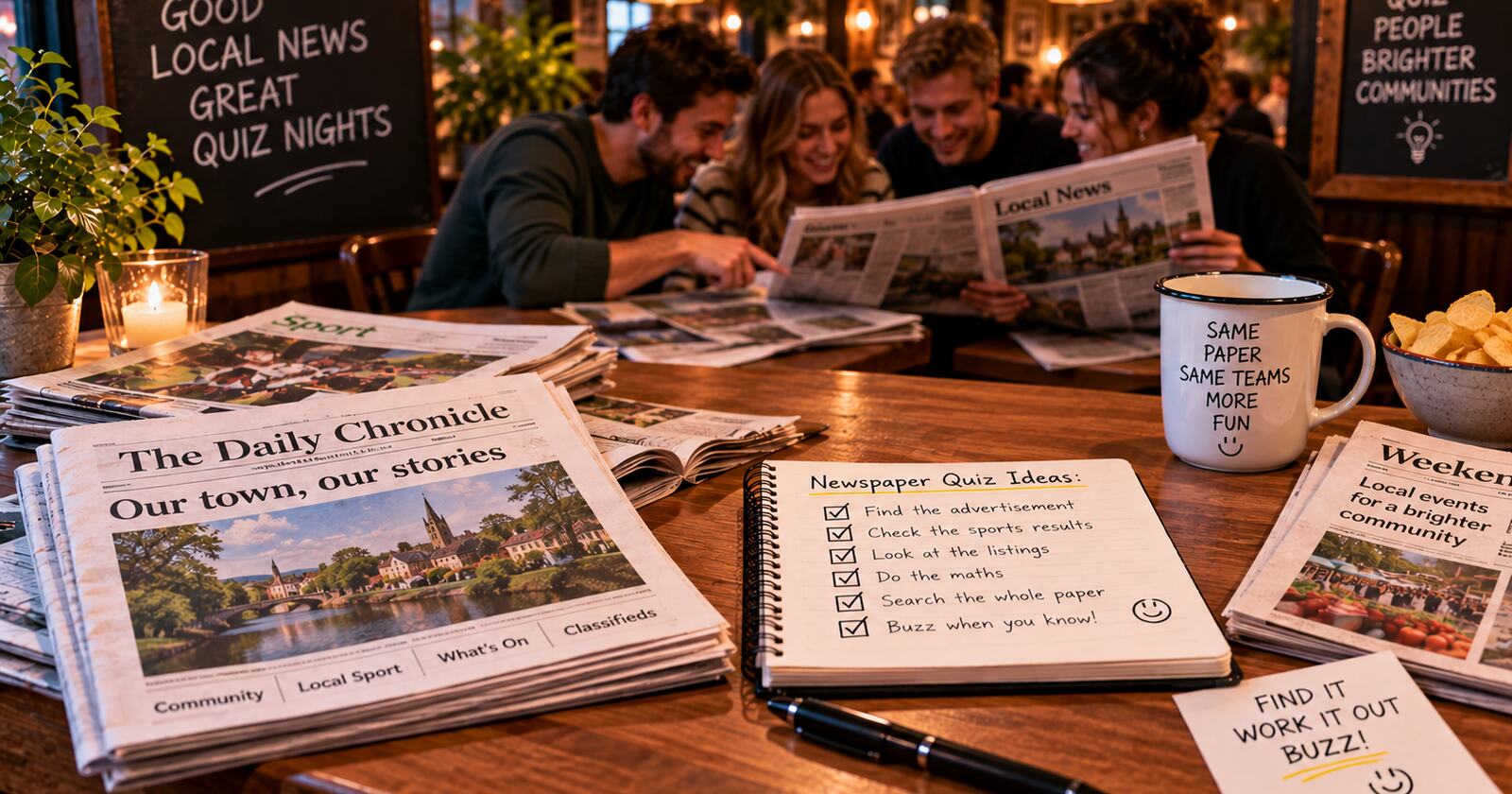
Give every team the same local newspaper. Give them a few minutes to look through it. Then start asking questions.
The newspapers stay on the table.
Now the race begins.
A question is asked. Teams start flipping pages, scanning headlines, checking advertisements and pointing at things they think might contain the answer. The first team to find it hits the buzzer.
If they're right, they get the points.
If they're wrong, the search continues.
The newspaper isn't just where the questions came from.
The newspaper is the game board.
And because everyone is searching the same newspaper at the same time, this works particularly well as a team game, for an office quiz, sports club, community group or quiz night.
Get your teams and newspapers ready
You'll need teams rather than individual players for this format.
There are two important bits of practical setup before you start. You need one copy of the same edition for every team, so buy five or six copies of Thursday's paper rather than one, and check they're identical before you hand them out. And each team buzzes from a single phone, joined under the team name. One device per table, not one per person, or you'll have five people on the same team racing each other.
If you're running an office quiz or a club night, you can of course make the teams yourself. But if you want genuinely random teams, use the QuizLinq Random Team Generator.
Paste in everyone's names, choose how many people you want per team, and generate the teams. You can then put the results on a projector or TV so everyone can see which team they're on.
It's free, requires no account, and the names stay in your browser rather than being uploaded to a server. It supports up to 250 participants.
Teams sorted. Newspapers ready. Let's play.
Use a local newspaper
For the best results, use a local newspaper.
A national newspaper gives you plenty of information, but a local paper gives you something more valuable: familiarity.
Your players are more likely to recognise the local supermarket, restaurant, football club, theatre, businesses and places mentioned in the paper. They may even know some of the people in the photographs.
That makes the search interesting without making the answers too easy.
A local advertisement might become:
According to the advertisement from the local butcher, how much would 750 grams of the advertised beef cost?
Or a sports result could become:
Which team scored the most goals in yesterday's local football results?
The players know what they're looking for, but they still have to find it.
And that is exactly what you want.
Give them time to explore
Before the quiz starts, give every team the same newspaper and a fixed amount of time to look through it.
Five minutes is usually plenty, though a fat weekend edition or a room full of teams may want a little longer.
Tell them to look through the whole thing. Read the headlines. Check the sports pages. Look at advertisements. Notice unusual stories.
But don't tell them what you're going to ask.
They don't know which part of the newspaper will matter later, so they have to decide what is worth remembering.
Then start the quiz.
The newspapers stay on the table.
Ask questions they have to find
The best questions aren't things players can answer from general knowledge.
They need the newspaper.
Suppose the newspaper contains a fast food advertisement with several menu prices. You could ask:
According to the advertisement, how much would two burger meals and a large fries cost?
The teams have to find the advertisement, locate the relevant prices, add them together and buzz.
Or perhaps an electrical retailer's advertisement contains three televisions, each with a different screen size and price:
Which of the three advertised televisions has the lowest price per inch?
Finding the advertisement is only the first step. The team then has to extract the information and work out the answer.
That's where the fun starts.
Find it, then work it out.
You can use the same idea with advertisements, articles, tables, sports results, schedules or anything else in the newspaper. For example:
Which advertised drill has the largest percentage discount?
The sports section lists yesterday's results. Which team scored the most goals?
According to the concert advertisement, which artist is performing on Saturday?
The newspaper lists three local events. Which one starts earliest?
The important part is that the newspaper contains the information needed to answer the question.
If you can answer the question without looking at the newspaper, it's probably not a good newspaper-quiz question.
Don't give them a map
There is a temptation to make the questions easier by saying where the information can be found.
Don't.
Don't say:
On page 12, there's an advertisement for the garden centre. How much...?
That turns the game into a simple lookup exercise.
Instead, give teams a useful clue without giving away the location:
According to the garden centre advertisement, how much would three bags of compost cost?
Now the teams have to find the advertisement themselves.
The question tells them what to look for, but not where to find it.
That distinction makes a big difference.
The buzzer changes everything
Without a buzzer, the newspaper quiz is essentially a scavenger hunt.
With a buzzer, it becomes a race.
As soon as a team thinks they've found the answer, they can buzz.
That creates a new decision:
Do you keep searching, or do you commit?
Buzz too early and you might have misread the advertisement.
Wait too long and another team might find it first.
And because the newspapers remain on the table, every team can keep searching. If a team buzzes and gets it wrong, the other teams get their chance.
Worth knowing: the buzzer determines who gets the chance to answer, not how quickly they then have to give it. Once you've buzzed, take the time you need.
It's a similar tension to a Buzz Too Early and You Look Like a Genius. Or a Fool.: wait for more information and risk losing the race, or commit early and risk being wrong.
Suddenly, a completely ordinary newspaper becomes a surprisingly effective game board.
Make the questions progressively harder
You don't need every question to require complicated calculations.
Mix things up.
Start with something teams can find quickly:
Which company is advertising a new electric car?
Then make them work a little harder:
What is the advertised price of that car?
And eventually combine finding information with reasoning:
According to the advertisement, how much would the car cost after the advertised discount?
You can also make teams connect information from different parts of the newspaper.
The more information they need to find and combine, the more frantic the search becomes.
Why it works so well for teams
A good team divides the newspaper between them without being told to. One person takes the advertisements, another the sports pages, someone else scans the news, and when a question needs a calculation a fourth is already working it out.
That's part of the game.
You're not just testing who knows the most. You're testing how well a team can search, communicate and commit under pressure.
Which is why it works so well for an office quiz or a sports club. Someone who would sink without trace in a traditional trivia round can be the one who spots the advertisement, or the one who does the arithmetic, or the one who understood what was actually being asked.
That's the same reason interactive formats have crept into meetings and away-days: Microlearning in Team Sessions - Turning Passive Audiences into Participants makes the case for participation over presentation, and a newspaper round is about as far from a slide deck as you can get.
And someone still has to decide:
"Buzz now?"
If you can't get a newspaper
A company newsletter works. So does a community magazine, an event programme, a club newsletter or a school paper. Anything with advertisements, listings, photographs and names in it will do the job.
The test is familiarity rather than format. The more the material belongs to the people in the room, the more fun it is to search through, which is also why a local paper beats a national one.
A newspaper is more than a source of trivia
That's what makes this format different from simply writing questions based on the news.
The newspaper isn't just providing facts for you to turn into questions.
It is part of the gameplay.
Teams physically search through it. They discover information. They make connections. They decide when they know enough to buzz.
The information is right there in front of them.
They just have to find it before somebody else does.
And that makes for a quiz where even a question about the price of a hamburger can become a race.
Give every team a newspaper. Ask the question. Start the clock.
Then let them search.