
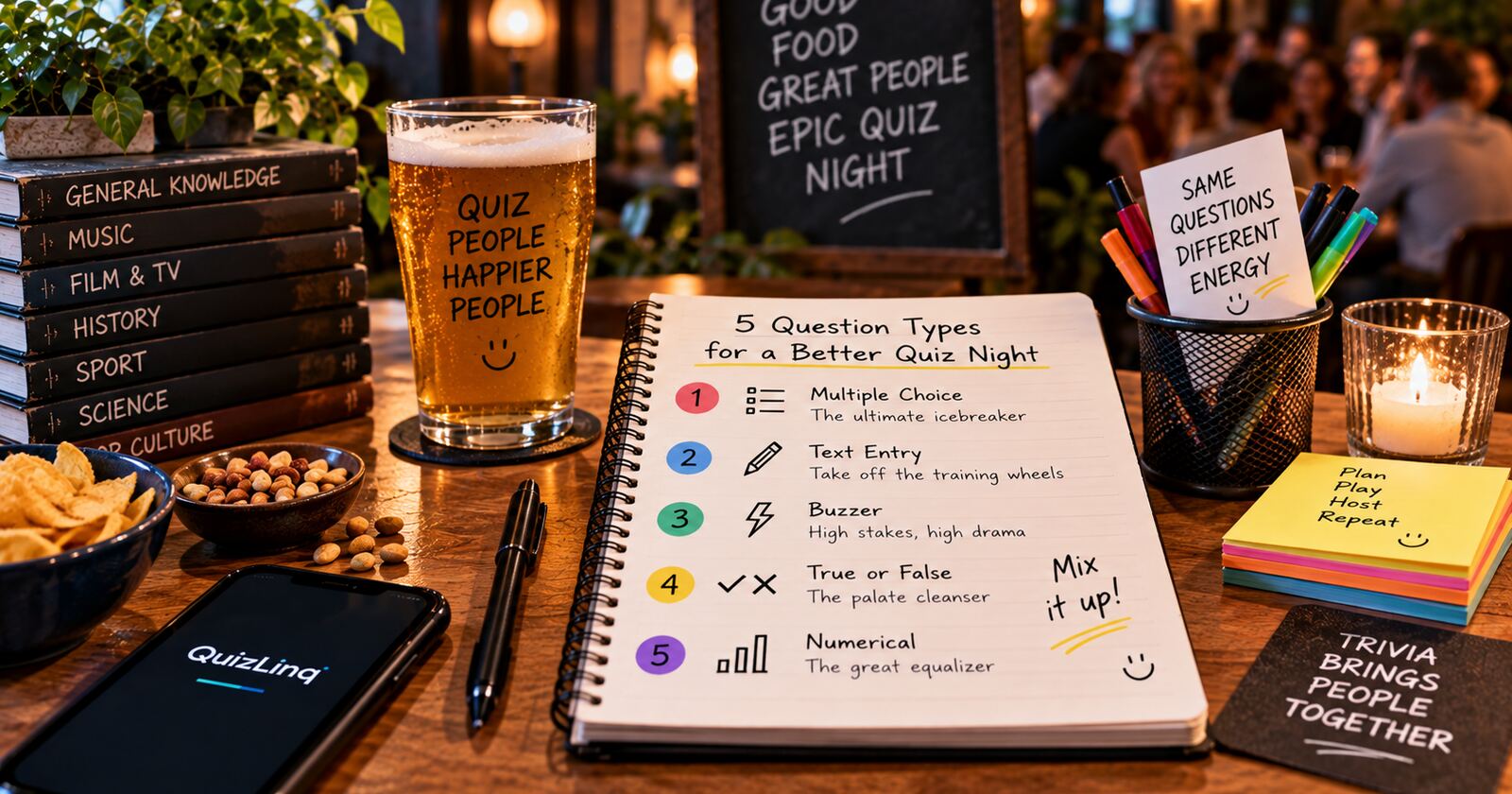
We’ve all been there: sitting through a quiz that feels more like a school exam than a night out. Ask a question, pick A, B, or C, repeat for two hours. It works, but it’s not exactly legendary.
The secret to a great quiz night isn't just having "hard" questions—it’s about changing the way your players think. Whether you’re using a high-tech platform or old-school pen and paper, mixing up your formats is what keeps the room buzzing.
Here are five question types every host needs in their toolkit and how to use them effectively.
1. Multiple Choice: The Ultimate Icebreaker
Multiple choice is the "comfort food" of trivia. It’s great because it gives everyone a "puncher’s chance." Even if a player is totally stumped, they’ve still got a 25% shot at glory.
Pro-Tip: The "art" here is in the wrong answers (the distractors). Avoid obvious duds. If you're asking about geography, don't use "The Moon" as a wrong answer. Use "Budapest" or "Prague"—something that makes them second-guess their gut instinct.
Best for: General knowledge, family events, and getting the room settled in the first round.
2. Text Entry: Taking Off the Training Wheels
This is where things get serious. Text entry (or "open-ended" questions) rewards the purists who actually know their stuff. There’s no safety net here; you either know it, or you don't.
The Modern Twist: If you're hosting digitally with a tool like QuizLinq, you don't have to be a "spelling cop." You can use Automatic Answer Matching set to "Moderate" to allow for minor typos, so the game keeps moving even if someone's thumb slips on the keyboard.
Best for: Specialist rounds, "Name that Movie," and mid-quiz rounds when the "casuals" need a challenge.
3. The Buzzer: High Stakes, High Drama
Nothing gets the adrenaline pumping like a Buzzer round. It transforms a quiz into a high-stakes game show. Suddenly, it’s not just about what you know; it’s about who can react the fastest.
The Strategy: Use this sparingly. One buzzer round per night is the sweet spot. Save it for a moment when the energy starts to dip or for a high-tension final round where the top two teams are neck-and-neck.
Best for: Final rounds, tiebreakers, and anytime you need to wake up the back of the room.
4. True or False: The Palate Cleanser
True or False rounds are faster and punchier than they look. They act as a great "reset" button between longer, more intense rounds.
The Hook: The best T/F questions are the ones that sound like total "fake news" but are actually true. It forces players to commit. There’s no hedging your bets—it's 50/50, all or nothing.
Best for: Quick-fire rounds and clearing the air between "heavy" categories like History or Science.
5. Numerical: The Great Equalizer
Numerical questions are a secret weapon for any host. When you ask, "How many steps are in the Eiffel Tower?" almost nobody knows the exact number, but everyone has a "ballpark" guess.
Why it works: It levels the playing field. The pub trivia expert and the first-timer have equal standing here. If you're hosting with QuizLinq, you can set a Margin (like +/- 50), so anyone who gets "close enough" bags the points. It’s about being in the right neighborhood, not having the exact address.
Best for: History dates, sports stats, and those "how many" questions that keep the room debating.
The Winning Formula
A truly great night is all about the flow. Start with Multiple Choice to build confidence, move to Text Entry when they're focused, and close with a Buzzer or Numerical round for a cinematic finish.
By varying the way you ask questions, you aren't just running a quiz—you're hosting a show. Mix it up, keep it moving, and your players will be asking when the next one is before the final leaderboard even clears.
All five of these formats are built into QuizLinq, so you can try the full mix at your very next quiz night.
Never hosted before? Our guide to running your first pub quiz covers the pacing, timing and mic work that make these formats actually land.