
You've found the song. You've trimmed the clip. Maybe you've even slowed it down, reversed it or removed the vocals.
Now comes the part that can make an even bigger difference:
How should your players answer?
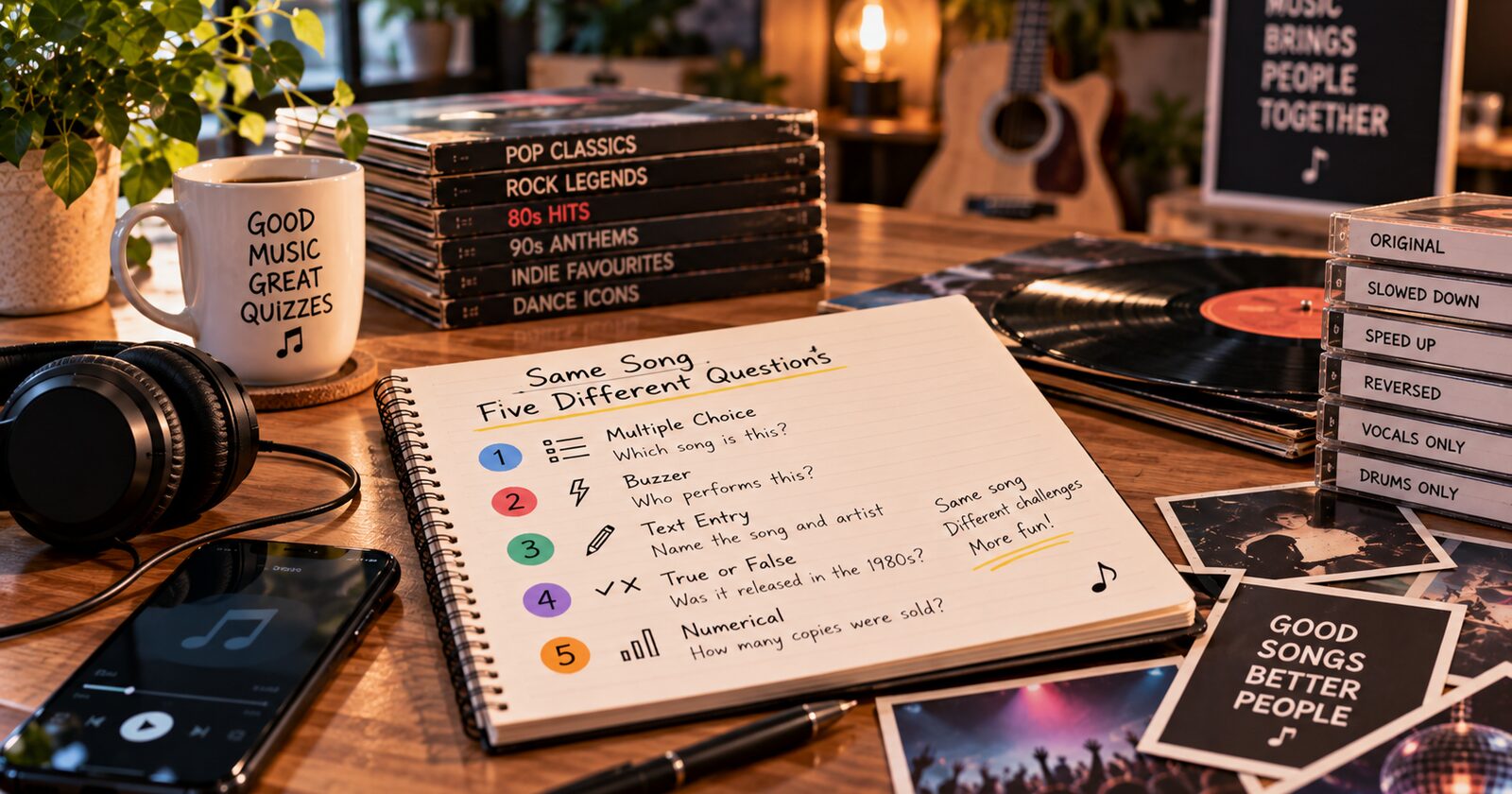
The same song becomes five completely different questions depending on the format you choose. A Buzzer question feels nothing like a Multiple Choice one. A Text Entry question rewards knowledge in a way a Numerical question never will.
So instead of always asking:
🎵 Which song is this?
match the question type to the kind of challenge you actually want.
Multiple Choice: easy to play, easy to understand
Multiple Choice is the classic starting point. Play a song, give people several options.
🎵 Play 10 seconds of a song
Which song is this?
A. Don't Stop Me Now B. Dancing Queen C. Take on Me D. Sweet Dreams
With four options, players have a 25% chance even when they've no idea, which is often exactly what you want in a casual quiz. Nobody sits there with nothing to do.
You control the difficulty through the options rather than the audio. Four unrelated songs is easy. Four songs by the same artist, four from the same decade, or four from the same soundtrack is considerably harder.
It also rescues difficult audio
Multiple Choice pairs well with the transformed audio from our other article, because the options give players a way in even when the clip is nearly impossible.
🥁 Play drums only
Which song uses this drum pattern?
Without options that question is brutal. With four, it becomes a reasonable guess for anyone who knows the era.
Text Entry: test whether they actually know it
Text Entry removes the safety net. Players type the answer themselves, which is the difference between "I recognized it" and "I know what this is."
🎵 Play a song
What song is this, and who performs it?
You can ask for two things in one question and score them separately, so a team who knows the song but not the artist still gets something.
It's also the right choice for questions with no clean set of options:
Which artist performed this song?
What is the name of this band's lead singer?
Buzzer: who recognizes it first?
Music and speed go together unusually well. Play the first couple of seconds and let players buzz in the moment they know.
🎵 Play a very short intro
Who performs this song?
The challenge isn't just knowing the answer. It's getting there before everyone else does.
Buzzer works best with very distinctive intros, famous guitar riffs, iconic drum openings, signature vocal lines, and songs your particular room knows extremely well.
You can also make it harder with an altered version:
🥁 Play drums only
Buzz when you recognize the song.
Now the fastest player isn't the one with the fastest thumb. It's the one whose musical memory is good enough to work from almost nothing.
True or False: turn music into a statement
True or False is useful when you want to test knowledge about a song rather than simply identify it.
🎵 Play a song
True or false: this song was released in the 1980s.
Or make it more specific:
True or false: this song reached number one in the UK.
It gets more interesting when you combine a factual statement with unusual audio, because players have to recognize the song and evaluate the claim at the same time:
🎵 Play a pitch-shifted clip
True or false: this is a Beatles song.
Numerical: music is full of numbers
Record sales, streams, weeks at number one, release years, studio albums, concert attendance, song length, band members. Music trivia is unusually numerical, which makes this format more useful here than almost anywhere else.
🎵 Play a song
How many copies of this song were sold?
Nobody knows that number. That's the point. Rather than demanding the exact figure, give the points to whoever guesses closest, and a question that would be unanswerable becomes one everyone can attempt.
Was it 5 million? 20 million? 50 million? Suddenly the room has to make a judgement, and the person who reasons it out beats the person who half-remembers a fact.
Questions that work well this way:
How many weeks did this song spend at number one?
How many million copies of this album were sold?
How many people attended this concert?
The fun isn't in knowing. It's in seeing who estimates best.
One song, many questions
Here's the part worth internalizing. You can take the same song and build a whole round out of it, and the answer reveal gives you a second piece of media for each one.
| Question audio | Type | Ask | Reveal |
|---|---|---|---|
| Original | Multiple Choice | Which song is this? | The album cover |
| 5-second intro | Buzzer | Who performs this? | The chorus |
| Reversed | Text Entry | Name the artist and song | The clip forwards |
| Drums only | Multiple Choice | Which song uses these drums? | The full track |
| Pitch shifted | True or False | True or false: this is Queen | The original |
| Original | Numerical | How many copies were sold? | A photo of the band |
| Musicless video | Text Entry | Name the music video | The real music video |
| Slow version | Buzzer | Buzz when you recognize it | Played at full speed |
You're not just choosing how players type an answer. You're choosing what kind of challenge you're setting them.
Mix formats within the round
A good music round doesn't stay in one gear. Open with an easy Multiple Choice to get everyone involved, use a Buzzer for speed, go to Text Entry for something harder, surprise people with a True or False fact, and finish on a Numerical estimate.
Question 1, Multiple Choice
🎵 Play the chorus.
Which song is this?
Question 2, Buzzer
🎵 Play two seconds of the intro.
Who performs this song?
Question 3, Text Entry
🎵 Play a reversed clip.
Name the song and artist.
Question 4, True or False
🎵 Play the original song.
True or false: this song was released before 1990.
Question 5, Numerical
🎵 Play the song.
How many copies were sold worldwide?
Same general topic. Five completely different experiences.
Match the format to the challenge
There's no universal rule, but this is a reasonable starting point:
- Want an accessible question? Multiple Choice.
- Want to test actual recall? Text Entry.
- Want speed and noise? Buzzer.
- Want to test knowledge rather than recognition? True or False.
- Want estimation? Numerical.
And you can deliberately break all of that. Some of the best questions come from using the wrong format on purpose.
Where to go next
Every question type here is in QuizLinq Free, along with audio on your questions and separate media on the answer reveal, so a round with real variety in it costs nothing to build.
If you haven't worked out how to source and prepare your music yet, start with How to Add Music to Your Quiz: YouTube, MP3 and More.
And if you want to make your audio more unusual before you build the question, take a look at Slow It Down, Reverse It, Strip the Vocals: Creative Music Quiz Audio Tricks.
The right audio and the right format together are where a decent music quiz turns into a memorable one.