
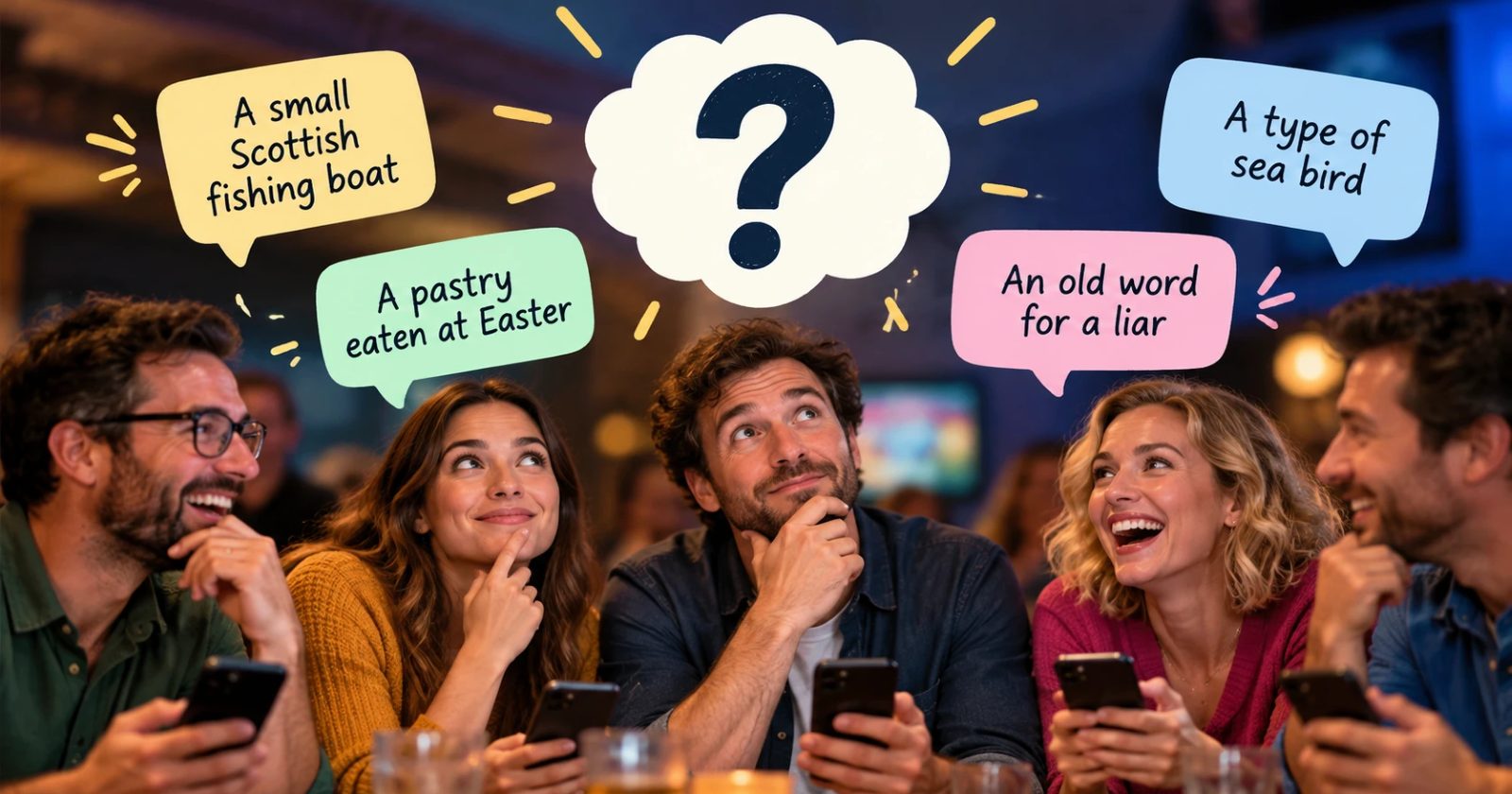
In a regular quiz, knowing the answer gives you an advantage. But what if you don't know it? With Bluff, you can still score points, by making up an answer convincing enough that someone else believes it.
Bluff is a QuizLinq question type that turns obscure trivia into a game of creativity, persuasion and second-guessing. The goal isn't just to find the truth. It's also to convince everyone else that your answer is the right one.
How Bluff works
It's a different kind of party quiz game: you don't need to know the answer to score points. Sometimes making up the most convincing answer is worth more. The host creates a question with a real answer that few people are likely to know.
What is a snollygoster?
Instead of simply guessing, every player invents a believable fake answer. One might suggest a small fishing boat, another an Easter pastry, and someone else an old word for a liar.
The host reviews the submissions on the Quiz Remote before the answers are shown to the room. Then everyone picks the answer they believe is correct. Players can't select their own bluff.
There are two ways to score:
- Find the truth: Earn points for selecting the correct answer.
- Fool the room: Earn bluff points for every player who chooses your fake answer.
The reveal shows the correct answer first, followed by the bluffs that fooled people and the names of their authors.
A snollygoster is actually a shrewd, unprincipled person. The word is real, and that is precisely what makes it a good Bluff question. When the truth sounds made up, and the made-up answers sound plausible, the game gets interesting.
Why Bluff works
Bluff gives everyone a reason to take part, regardless of how much they know about the subject. You might not know the answer, but you can still invent something convincing. And if you do know the answer, you have an advantage: you can use that knowledge to come up with a bluff that competes with the real answer and fools the room.
The reveal adds another layer. Finding out that half the room believed an invented answer is funny enough. Finding out who invented it makes it even better.
Bluff also rewards a different kind of skill. It's not about knowing more facts than everyone else. It's about understanding what people will believe.
What makes a good Bluff question?
The best questions leave room for imagination. Keep these principles in mind when creating your own.
Choose something few people know. If everyone knows the answer, there is little room for deception.
Look for surprising truths. The real answer should be interesting enough that players might mistake it for a bluff.
Keep the answer unambiguous. There should be one clear correct answer, even if players phrase it differently.
Leave room for creativity. Questions about obscure words, unusual names and strange facts tend to work better than questions about dates or numbers. Answers like 1987 and 1989 don't leave much room for convincing bluffs.
Here are a few formats to try:
- Strange words: What is a snollygoster? What does petrichor mean? (The smell of rain on dry ground.)
- Collective nouns: What is a group of flamingos called? (A flamboyance.)
- Original names: What was Google's original name? (BackRub.)
- Strange but true: What is the national animal of Scotland? (The unicorn.) In 1932, Australian soldiers went to war against which animal? (Emus.)
- Personal trivia: What was our CEO's first job? What did Grandad call his first car? Questions about a team or family can be particularly effective because the players know one another, but the answer may still surprise them.
Tips for hosting Bluff
Add backup bluffs
You can add two or three backup bluffs when creating a question. These help fill out the options if players submit too few bluffs, making the question more reliable in smaller or quieter groups.
Make your backups believable. An obviously fake answer can make the real one too easy to spot.
Review the submissions
Before players choose an answer, you can review the bluffs on your Quiz Remote. Automatic matching handles some duplicates and answers that match the correct answer, but you can also make adjustments yourself.
Remove anything inappropriate, mark an alternative wording as correct when necessary, or merge bluffs that mean the same thing. Merging matters: when two options say the same thing in different words, players can tell they're both bluffs, because the real answer only appears once. Merged, players see just one, and its writers share the points. The host controls what reaches the room, which is useful for both professional and social quizzes.
Keep this step moving, though. Players are waiting to find out which answer to choose.
Set the timing and points
Bluff has separate time limits for writing answers and choosing the correct one. Give players enough time for the creative part: inventing a believable answer takes longer than selecting an option.
You can also set the points for finding the truth and the bluff points awarded for each player fooled. In larger groups, bluff points can accumulate quickly, so consider balancing the two scores to suit your quiz.
Don't be afraid to skip a question
Sometimes a question doesn't work out. Perhaps too many players know the answer, or the submitted bluffs aren't suitable. Select Skip question and nobody scores for that question.
Bluff works in big rooms, too
When there are more than 12 answer options, each player receives a selection of bluffs alongside the correct answer. This keeps the list manageable on phones, even with a large audience.
Because players see different selections, the big screen doesn't list all the options in this situation. The reveal still shows the bluffs that fooled people and who submitted them.
How to use Bluff in your quiz
A few Bluff questions mixed into a regular quiz add an unexpected twist. They give players a chance to score through creativity rather than knowledge, without changing the format of the whole event.
You can also dedicate an entire round to Bluff. Once players get into the spirit of inventing convincing answers and spotting everyone else's, a full round can be great fun.
Try Bluff in QuizLinq
Bluff is a QuizLinq Plus feature, and you can try it for free in a test run. Virtual players submit bluffs, letting you experience the review and reveal before using it in your own quiz.
Create a question, let everyone get creative, and see who can convince the room.